
About
A science of morality veiled in allegory and illustrated by symbols…
Since time immemorial, these words have been used to frame the spirit of Freemasonry as a mysterious force designed to elevate the hearts and minds of its practitioners through the use of archaic traditions and sacred rites. Freemasonry draws many of its allegories from lessons taught by tradesmen of the Medieval craft guilds—particularly those of the stonemasons whose craft was performed with such geometric precision as to erect some of the most beautiful, resilient and elaborate cathedrals, monuments and edifices the world has ever known. So awe-inspiring were these structures, that the tools and techniques used in their construction were often considered trade secrets whose details were conferred upon only to the most meritorious craftsmen deemed sufficiently worthy to advance through the ranks of the stonemason guilds—entering first as an apprentice, before advancing to journeyman status (or “fellow of the craft”) and finally being recognized as a master mason. As in the modern era, a Medieval stonemason’s work was purely contractual in that the onus fell on the craftsman to secure other employment upon completion of a project. To communicate his credentials to prospective employers, stonemasons would use various handshakes and passwords indicative of his status as either an apprentice, journeyman or master mason. In an era when the overwhelming population was functionally illiterate, these secret signs were used as a means to ensure that the most meritorious of the craftsmen were able to secure future employment.
As an homage to the operative masons of old, the fraternal orders of Freemasons that arose during the Enlightenment adapted these various gestures, signs and ciphers to better enable themselves to recognize one another and their standing in the organization. The secrecy with which these signs were conferred has been the subject of many a conspiracy theory, leading to accusations that Freemasonry serves only to elevate and ennoble those with sufficient means, connections or resources, however; nothing can be further from the truth. To the contrary, Freemasonry teaches its practitioners that only after demonstrating sufficient proficiency in the Craft may one advance through the ranks of the fraternity and merit the rights and privileges of full membership. We are taught that neither a Mason’s wealth nor their vocation nor their station in life are material in Freemasonry—only that they demonstrate a vested interest in bettering themselves and others for the benefit of the common good.
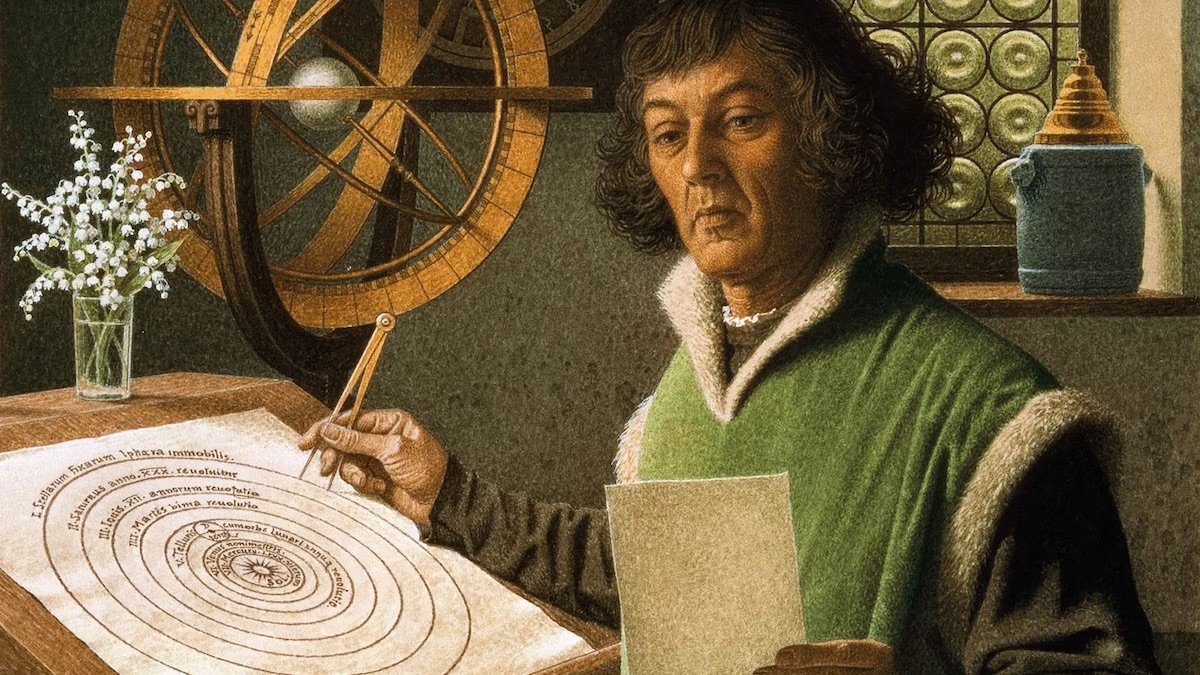
Though often best remembered for his contributions to mathematics and astronomy, Nicolaus Copernicus was a Renaissance Man in the truest sense of the word. Enchanted by the liberal arts and propelled by the pursuit of knowledge, Copernicus attended numerous educational institutions including the University of Kraków , University of Bologna and the University of Padua before ultimately earning his doctorate in Canon Law at the University of Ferrara in 1503 at the age of 30. After entering the priesthood, Copernicus continued his studies of the celestial bodies from his observatory at Frombork Cathedral until his death in 1543.
Cathedral Basilica of the Assumption of the Blessed Virgin Mary and St. Andrew in Frombork, Poland is the cathedral where Nicolaus Copernicus served as Canon during his scientific career and published his magnum opus, "On the Revolutions of the Heavenly Spheres", proposing the heliocentric model of the solar system. To the right is a monument marking his final resting place.
Nicolaus Copernicus - A Revolutionary Thinker
As the world’s oldest and largest fraternity swelled in membership during the Age of Enlightenment, it became necessary to organize Freemasons into individual lodges, where regular assemblies could be held to perform Masonic rituals and conduct business. Centuries ago, it was not uncommon for those of a similar vocation to gravitate to a lodge whose namesake was associated with their profession (e.g., musicians in Mozart Lodge; for academics, there was University Lodge). Though the character and culture of each newly established lodge would become as unique as those who constituted it, undergirding each chapter was a reverence for the seven liberal arts—grammar, rhetoric, logic, arithmetic, geometry, music and astronomy—those branches of learning greatly esteemed by our ancient brethren in Freemasonry. In continuing with this time-honored tradition, the founders of our humble lodge deemed it fitting to name itself after none of other than Nicolaus Copernicus—one of history’s most celebrated scientists whose contributions to mathematics and astronomy ushered in the Scientific Revolution, thereby bridging the Renaissance period with the Age of Enlightenment.
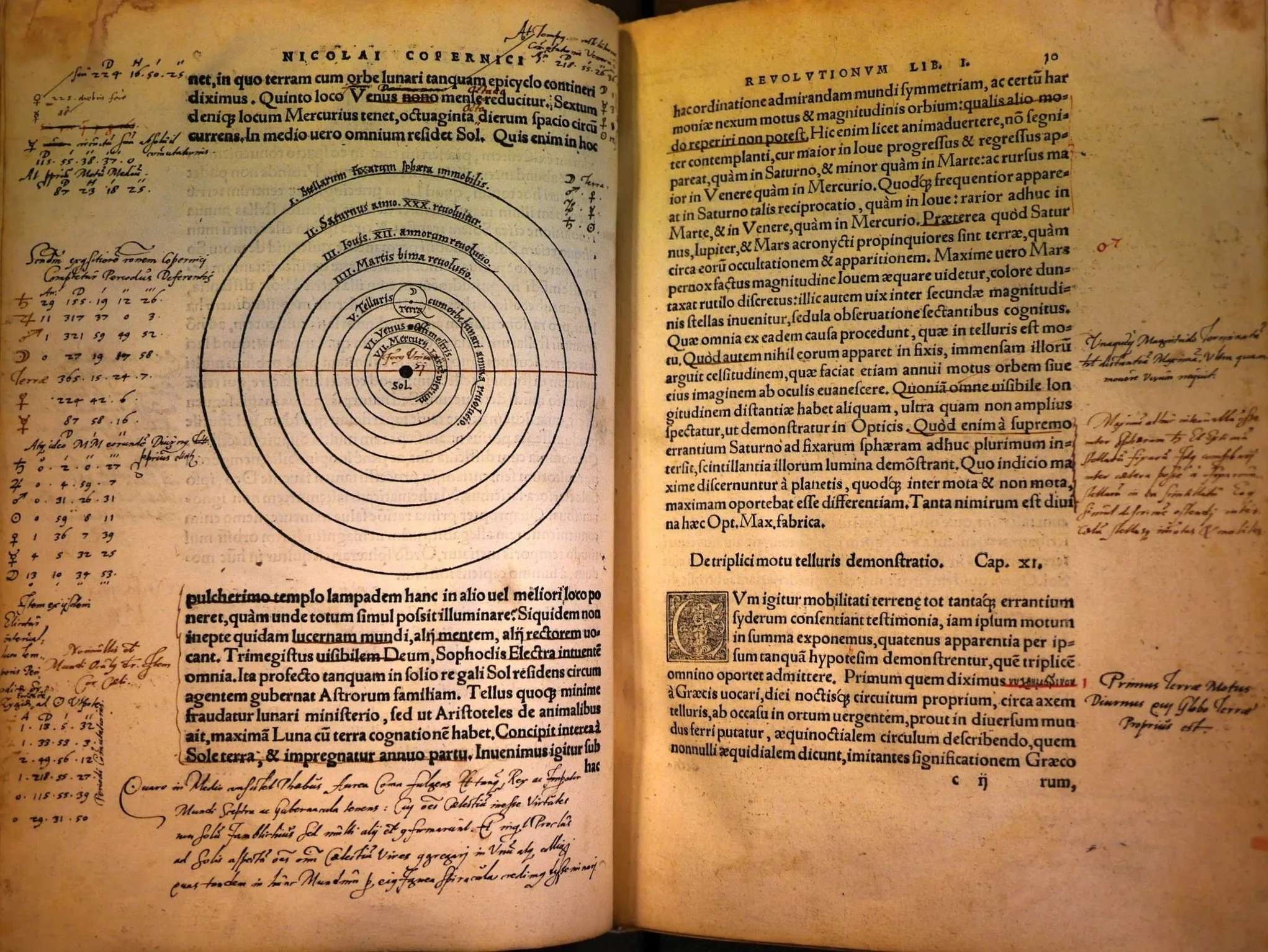
A polyglot and polymath, Copernicus was a true Renaissance man, having served as a mathematician, astronomer, physician, classics scholar, diplomat, economist and Catholic priest at various stages of his life in his native Poland. His breadth of knowledge spanned the celestial and the terrestrial for he was as much a man of the cloth as a disciple of science and leveraged his expertise in arithmetic, geometry and astronomy for the common good. As an economist, he proposed the quantity theory of money to explain price fluctuations due to inflation. As a diplomat, he helped ratify the Second Treaty of Piotrków Trybunalski which mediated territory disputes between the Prussian Confederation (allied with the Kingdom of Poland) and the State of the Teutonic Order. As an astronomer, his seminal work, On the Revolutions of the Heavenly Spheres, transformed our understanding of the cosmos by placing the Sun at the center of the solar system rather than the Earth, challenging centuries of established academic, philosophical and religious doctrine. Though not a Freemason himself, Copernicus’ tireless dedication to his craft epitomized the values we strive to inculcate in our members—namely, to harness the power of reason, logic and knowledge to revolutionize the world for the benefit of others.
On the Pursuit of Knowledge
“To know that we know what we know, and to know that we do not know what we do not know, that is true knowledge." - Nicolaus Copernicus
“I am not so enamored of my own opinions that I disregard what others may think of them.” - Nicolaus Copernicus