
A Journey to Saudi Arabia
The Kingdom of Saudi Arabia (KSA) is a country currently known the world over for its opulence, its oil, and its role as a global economic juggernaut situated at the heart of the Arabian Peninsula. Many civilizations have laid claim to Saudi Arabia, contributing to the region’s rich history of conquest and settlement. Pre-Islamic Arabia was formerly the site of the Kingdom of Lihyan from 600 BCE to 200 CE, whose people worshipped a pantheon of deities represented by sacred stones. An important religious center for this empire was Mecca which would later serve as the holiest city in the Islamic tradition. Pockets of Jewish and Christian influence—the latter controlling large swathes of territory—had established settlements on the western edge of the peninsula. The northwestern section of the peninsula was later renamed Arabia Petraea by the Roman Empire following their annexation of the region in 106 CE—dominion which would last until 630 CE.
The Islamic prophet Muhammed was born in Mecca in 570 CE, began preaching in 610 CE, and established the first caliphate shortly after. Through conquest, the various Arab tribes were united under a singular banner, which was succeeded by Abu Bakr following his death in 634 CE. Following sustained conflict with the Byzantine empire, the first caliphate fell in 750 CE, reverting to tribal dispersed rule after which the Ottoman Empire took control prior to being overthrown by the Saud dynasty whose family has ruled the country following the ratification of the Treaty of Jeddah in 1927. The discovery of substantial petroleum deposits in the Arabian peninsula has contributed enormously to the country’s wealth.
Modernization may well be on the way for Saudi Arabia. The present king, Mohammed bin Salman Al Saud (MbS), has constructed Saudi Vision 2030 in an effort to diversify the country’s economy and move the kingdom away from oil dependency. Women have gradually seen an expansion of their civil rights—if only on paper. The influence of the Committee for the Promotion of Virtue and the Prevention of Vice—Saudia Arabia’s “morality police” charged with the enforcement of the classical Islamic institution of hisba—has been severely curtailed. Women received the right to drive in 2017 and in 2018 were allowed to open a business without permission of a male guardian. The expansion of these liberties was in part driven by the influx of tourism to the kingdom. Nevertheless, Saudi Arabia’s track record on human rights and free speech violations is problematic to say the least, with perhaps no better recent example than the murder of The Washington Post journalist, Jamal Khashoggi, allegedly orchestrated by MbS himself.
The culture and people of Saudi Arabia represent a rich tapestry of Mediterranean, African and Asian influences. Islam remains the foundation of daily life, with five prayers dictating the rhythm of each day and Friday remaining a holy day when some businesses close. Though wholesome and family-oriented, the region’s cultural traditions remain staunchly patriarchal and religiously conservative.
Even over several millennia, hospitality remains a cornerstone of the Islamic tradition in which house guests may expect dates, coffee, or tea to be offered with constant regularity during their visit. Breakfast is often light, consisting of flatbreads, cheeses, dates, honey, jams, and coffee or tea. Lunch is the heaviest meal, consisting of a rice-based dish with meat. Dinner is lighter and tends to alternate between soups, stews, salads, and meat platters. Western influences and culinary trappings have begun to take root in Saudi Arabian cuisine, however; much of the country continues to observe a traditional diet.
Modesty remains a fixture of everyday living with men donning a long white robe, known as a thobe, and women wearing a long black cloak in public, known as an abaya. While etiquette may vary from one household to the next, public displays of affection are prohibited, and the fasting rituals associated with Ramadan are strictly enforced. During meals, women often are seated with curtains in separate areas to eat, as no one may see beneath the burqa aside from her husband and children as well as select relatives—the only notable exception being a pre-marital custom in which a prospective husband is permitted to see his fiancee’s face and hands to ensure compatibility.
The following exchange is from an interview between Bros. Spencer Talbot and Joseph Benzon—both of William L. Elkins Lodge No. 271—where the latter details his most recent trip to the Arabian Peninsula. Bro. Joseph Benzon has been a Freemason for over 11 years and currently serves as an event producer in the Greater Philadelphia region. The following content has been edited for clarity and brevity with the permission of all parties involved.
ST: To start, can you share with our listeners some of your hobbies and a little bit about yourself?
JB: Well, aside from traveling, I love all kinds of sports—both as a spectator and as a participant. I do travel to different parts of the world for one of my favorite sports: Muay Thai. I’m also an avid reader with a particular interest in journalism and literature and I frequent a ton of art galleries and concerts as well.
ST: I also heard you passed a Spanish proficiency test recently?
JB: I did! I advanced from level B1 to B2. There are different levels of Spanish fluency, however; B2 is the level in which you are considered fluent in conversation.
ST: That’s wonderful! Congratulations! Could you also speak to where you traveled most recently?
JB: In this most recent trip, I visited eight countries, one of which was Saudi Arabia where I spent a week.
ST: Could you give us an overview of your week there? Please feel free to share as much or as little as you like.
JB: Sure. Being a tourist, I went to several large scale events and learned about the country’s history from several of the local museums while making a point to interact with the locals both in Saudia Arabia as well as in the surrounding gulf coast countries adjoining Kuwait. I also visited their Six Flags in Qiddiya City , which was quite an engineering spectacle. I also visited Diriyah (i.e., the historic district within Saudi Arabia’s capital city, Riyadh), toured the city, the subways and various other areas.
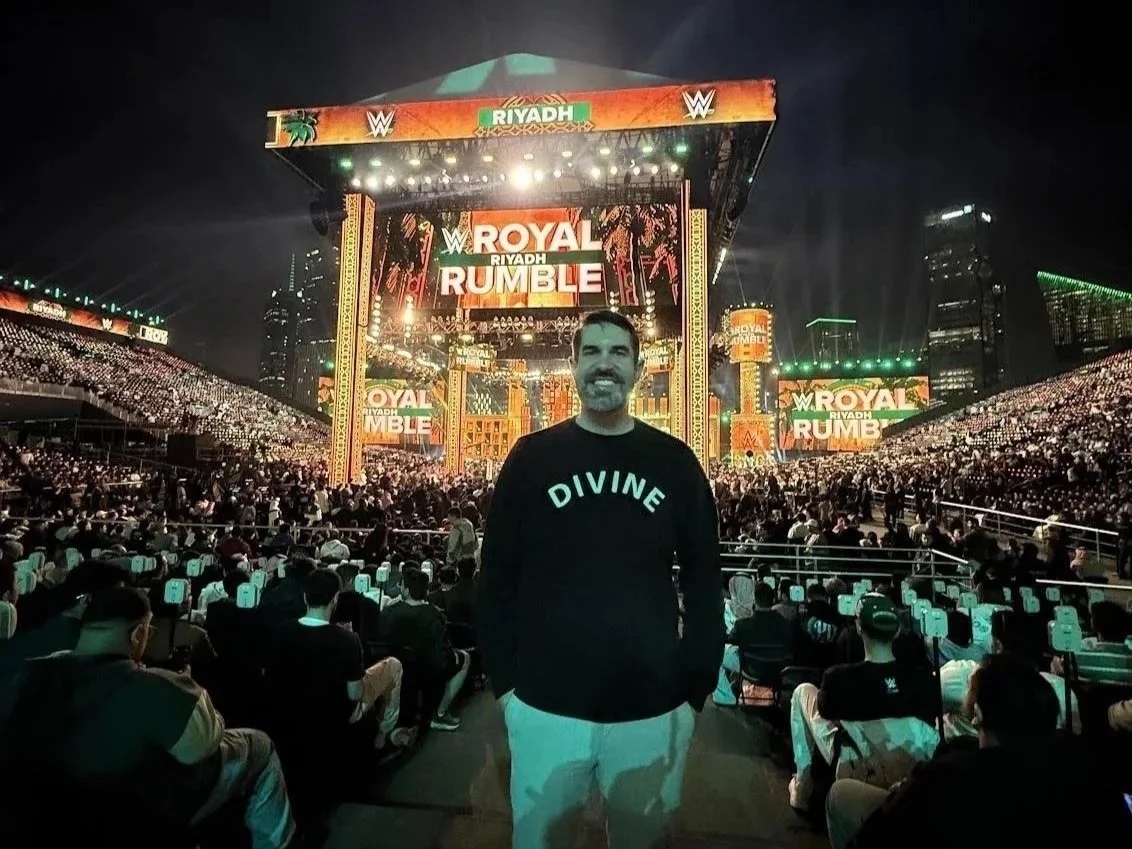
Bro. Joseph Benzon at a WWE wrestling match in Riyadh, Saudi Arabia’s capital.
ST: Let’s start with Six Flags. How was that experience?
JB: Six Flags was pretty cool. Saudi Arabia is trying its best to attract tourists by spending a lot of money to bring in world-class athletic events and attractions. Why else would you really want to go to Saudi Arabia when there are so many other places to visit? When I went towards the end of January, Six Flags Qiddiya City had just opened on New Year’s Eve and I must have been one of the first few thousand people to visit. They had announced as early as 2018 about their plans to install a roller coaster, which seemed impossible at the time—and most thought it was—but hey, they did it! It helps when they have virtually unlimited money and don’t care about a return on investment. They’ll never make their money back with the amount they put into it but I think their investment was an act of goodwill— an incentive to get people to visit and think that Saudi Arabia is cool. They had three roller coasters: the world’s tallest tilt coaster, the largest inversion coaster and their crown jewel, Falcon’s Flight, which mimics the swooping and irregular flight pattern of a falcon. It’s the fastest, tallest and longest roller coaster in the world!
ST: That’s incredible! Tell us about the old city you went to.
JB. The old city is called Diriyah. One thing to note about Saudi Arabia is that as they host these bigger events and build shinier things they are still trying to figure out how to cater to tourists. They have a pretty good metro system, but it doesn’t go out to the old city, so you have to take an Uber out there. There are plans to increase public infrastructure in the years to come and I’m sure they will have more in place before 2034 when they are set to host the World Cup. As of now, there are many places—as in, almost the entire city—that you can’t walk to at all. It’s a good place to start as many of these Middle Eastern countries reinvent themselves by building these shiny, fancy and new cities. (Dubai in the United Arab Emirates is only forty years old!) Uber is a good way to see how the area that would later become Riyadh was founded.
ST: How was it? Was it like going to an old section of London or Paris?
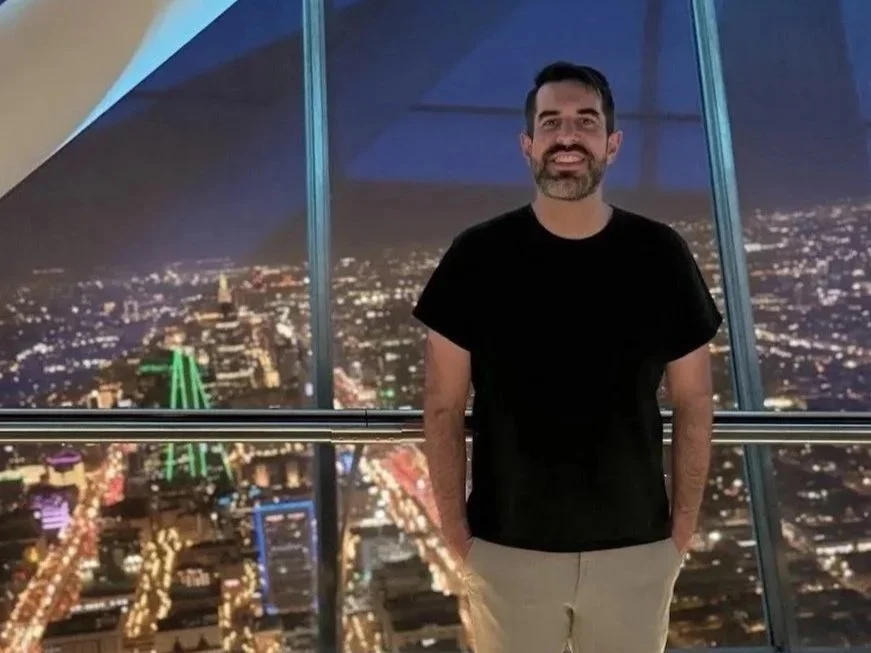
A bird’s eye view of Riyadh’s skyline from the highest point in the city.
JB: Definitely not since they don’t have any infrastructure surrounding it—it’s just surrounded by desert. Saudi Arabia is interesting in that regard. I’ve noticed this a lot about the Middle East: “you go to this place, see this thing, and that’s it.” You don’t walk to the next place through a neighborhood like Philly; you have to Uber there. Everything around you is a desert and then you just leave.
ST: So the local attractions were wonderful, but not walkable?
JB: I hated how un-walkable it was. It was my biggest gripe. I’m sure they’ll change it but it was incredibly unpleasant.
ST: Fair enough. As far as I’m aware, Saudi Arabia doesn’t allow for liquor purchases so what was your favorite food or beverage while there?
JB: In the entire country, aside from not having basic freedoms—especially for women—nobody is permitted to consume alcohol or pork. I don’t consume alcohol and don’t consume that much pork, so it wasn’t a huge change for me. Much of the region has similar cuisine—hummus, falafel, those types of seasoned foods. Chicken and other meats were plentiful, nothing too dissimilar to a Middle Eastern restaurant in America. Not reinventing the wheel, but still delicious.
ST: In your cultural experiences, would you consider anything you saw to be authentically “Saudi”?
JB: I would say a lot of countries over there do not ooze with culture. It’s not like being dropped in Philadelphia and finding it more wildly different from Louisiana. Saudi Arabia is shiny and new, and while that’s cool and nice to look at, it doesn’t leave you with any sort of “Wow! I was in Saudi Arabia, having been in this new shiny building.” Diriyah was the closest thing to an authentically Saudi experience that I visited in the entire city. Another place worth visiting and mentioning is “the edge of the world”. It’s an hour ride outside of Riyadh and many, many years ago, it was nothing but open ocean. Now it’s completely dried up, all desert, filled with carved out hills and valleys. You can hike to the top of it and look out to see the desert. It was really neat to see and you can see ancient history—long before the advent of civilization. Those two places stuck out as different. Most other parts of the city, you wouldn’t be able to tell it apart from any of the other cities in the region.
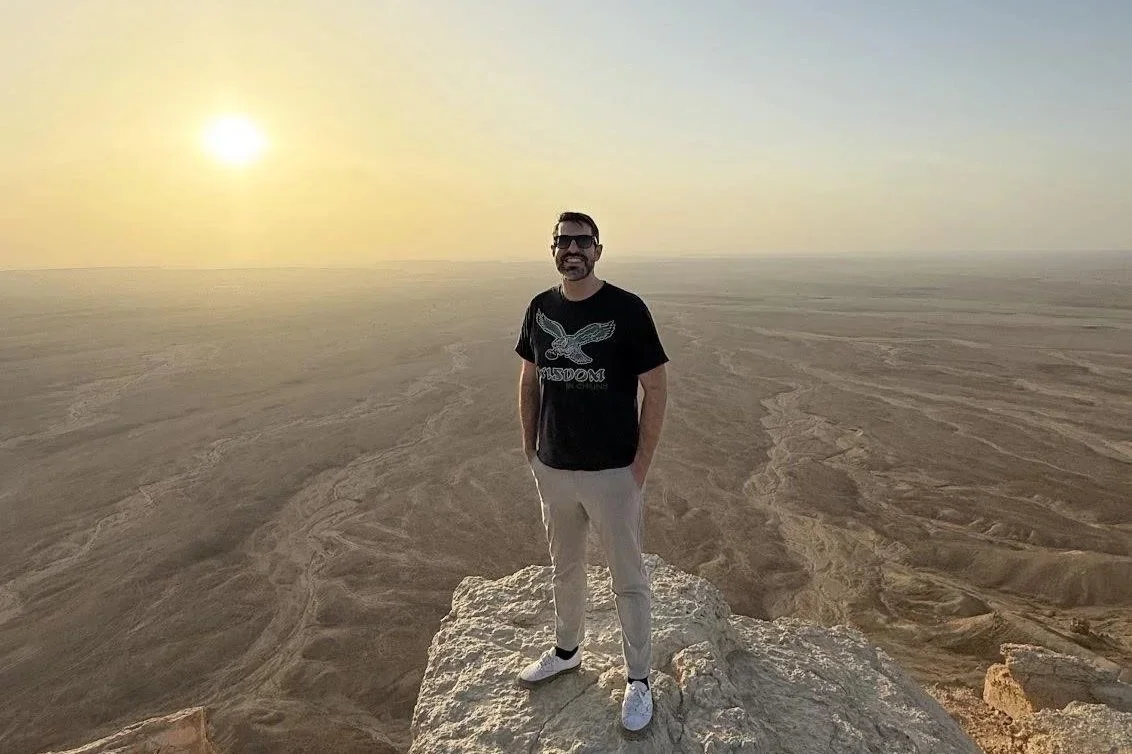
Bro. Joseph Benzon overlooking the “edge of the world” in the middle of the desert.
ST: Very cool. What was one thing that surprised you during your trip?
JB: I love traveling so much since in America, you can learn about different cultures and traditions whether in school or by reading books and learning what the day-to-day life is like in other countries, especially for women. But when you travel there and truly see it, it paints a different picture and humanizes it: as opposed to the portrayals in social media or Wikipedia. As an example: we obviously know that women have to cover their faces with hijabs. To see how women dealt with that on a daily basis was interesting. I took the metro everyday and it was packed—India or Bangladesh-style packed to the gills. It was interesting in that the front of the train was the first class car which costed way more, so you could see the wealthy whereas the family cabins were for women and children. Everyone else jammed into the regular cabins while women were segregated into their own train cabin. At McDonald’s, every single table has a curtain you could close so that women could pull down their hijab and eat their hamburger or French fries. Life is different for women there. In mosques, you see segregation with their own rules and regulations. To be a woman in that country, most Westerners know it’s quite different. To see it in person is a wildly different experience.
ST: Any recommendations on future places to visit for future travelers?
JB: The “edge of the world” is a must and Six Flags Qiddiya City is an impressive feat in engineering. I can’t believe they pulled it off; it’s wild. The World Cup is coming as is a Formula 1 racetrack. They’re also pumping billion of dollars into generating Western events so you are likely to have no shortage of attractions to visit in the coming years. Diriyah was also very cool. Those would be my tips.
ST: Any recommendations on culture, food or how to conduct yourself in Saudi Arabia?
JB: My recommendation is that you should conduct yourself with grace everywhere, most especially in Saudi Arabia. It is not a regime; it is a monarchy. It is not a place you want to mess around in. If you are a normal, law-abiding, friendly person, then it will not feel strict or overbearing, however; it is a place you can get into a lot of trouble. If you are a traveler who likes to bend the rules and party a bit, this is not your place.
ST: One last question: Any other remarks or comments regarding your time there?
JB: It’s interesting to see how folks there live. It is a deeply religious country as is the rest of the Middle East. They pray five times a day, everyday, and to see them stop to pray is very interesting: something we don’t see in the West. I wish they spent their money in more philanthropic ways, but they don’t. I definitely feel lucky to have avoided visiting Saudi Arabia now, and I’m disappointed that Americans are being left stranded overseas. I hope this situation resolves soon and I wish them safe travels home.